
Separate three different numbers
The purchase budget covers the price, inspection, transfer-related payments and immediate work. The running budget covers insurance, circulation licence or road tax, roadworthiness testing, servicing, tyres, energy, parking and repairs. The economic ownership cost also includes depreciation and, where applicable, finance interest and fees.
Do not add the entire purchase price and depreciation to the same annual cost total. Loan principal is a cash repayment that builds ownership; counting it alongside depreciation as another economic expense would also distort the comparison.
Build the budget from the actual vehicle
Obtain an insurance quotation for the driver, car and cover required. Check the actual road-tax record and roadworthiness deadline rather than using another owner's figures. Ask a workshop for the next scheduled work, tyre specification and likely near-term repairs.
For fuel, multiply annual kilometres by litres per 100 km, divide by 100 and multiply by your assumed EUR per litre. For an EV, use kWh per 100 km and the electricity price you actually expect to pay, allowing for charging losses and a mix of home and public charging. The electric-car guide explains the practical charging questions.
Worked example: a planning exercise
The following example is dated 14 October 2026. Every amount is an illustrative input, not a sampled market price, verified fee, insurance quote or Cyprus average. It models a cash purchase held for five years. Replace every input before using it for a decision.
| Item | Illustrative assumption | Annual equivalent in EUR |
|---|---|---|
| Depreciation | Purchase 12,000; resale 7,000 after 5 years | 1,000 |
| Insurance | 500 per year | 500 |
| Road tax | 120 per year | 120 |
| Roadworthiness test reserve | 40 allocated over 2 years | 20 |
| Servicing | 350 per year | 350 |
| Tyres | 400 allocated over 4 years | 100 |
| Fuel | 12,000 km; 7 L/100 km; 1.50 EUR/L | 1,260 |
| Parking | 25 per month | 300 |
| Unexpected repair reserve | 500 per year | 500 |
| Total planning allowance | Running costs plus depreciation | 4,150 |
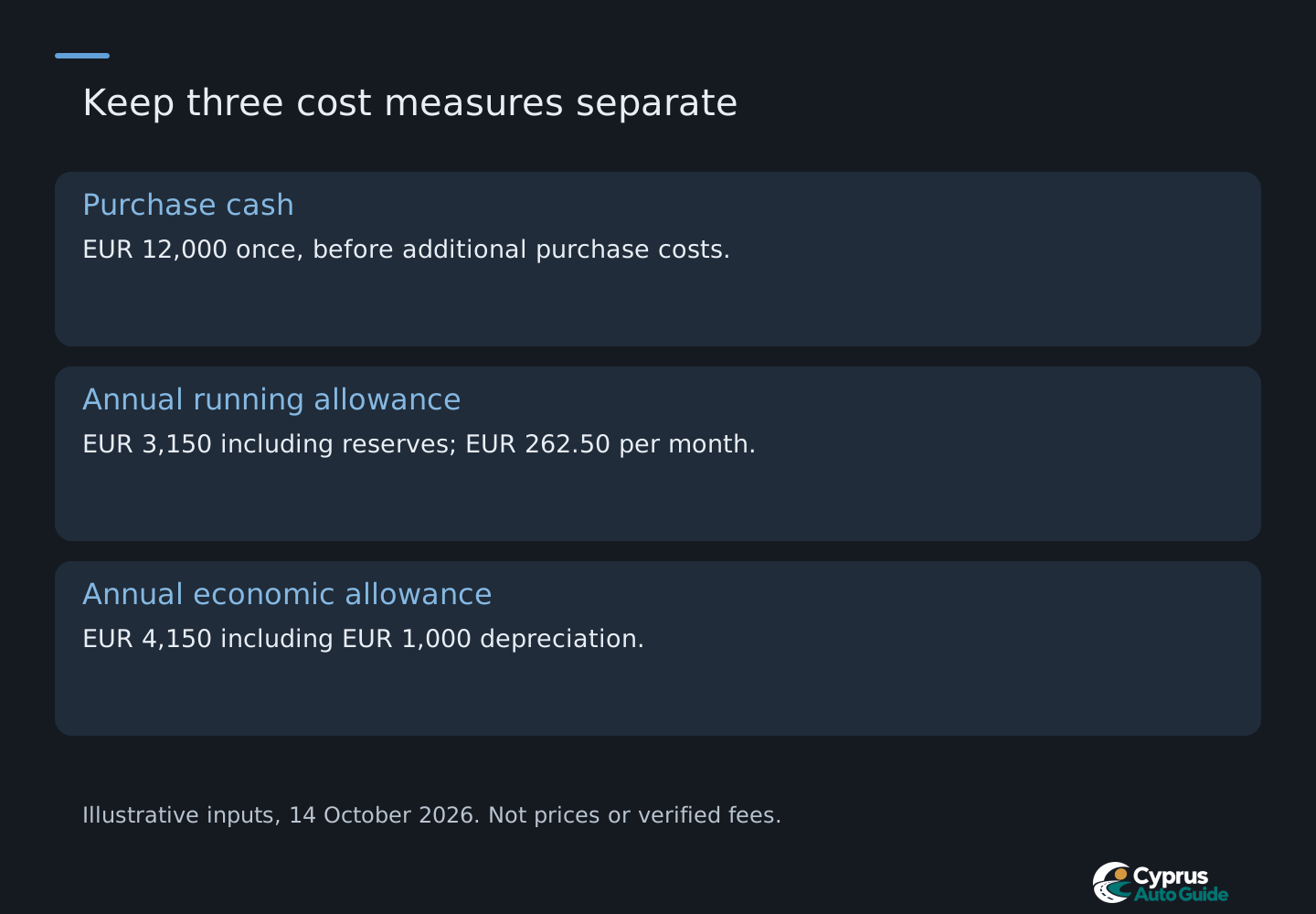
Running costs and reserves total EUR 3,150 annually, or EUR 262.50 monthly. Adding depreciation gives EUR 4,150 annually, about EUR 345.83 monthly. The test and tyre allocation periods are arithmetic assumptions, not legal intervals or predictions of tyre life. Unspent reserves remain money you have set aside, not completed expenditure.
Keep cash and finance on a separate line
In this example, year-one cash funding is EUR 12,000 for the purchase plus the EUR 3,150 running allowance: EUR 15,150 before inspection, transfer-related payments and initial repairs. Those additional items are excluded because they need separate quotations. Depreciation is not added again to that cash figure.
For a financed purchase, record the deposit, repayments and any final payment in the cash plan. Add interest and fees to the economic comparison, with their timing clearly stated. Do not put the financed purchase price, all principal repayments and depreciation into one total.
Use the editable budget table supplied with this guide to replace the example inputs. Before committing, connect the budget to the used-car buying checks and your insurance quotation. A cheaper purchase can still require more cash soon after handover.
Editable ownership budget
Edit your inputs and recalculate. This is an editable planning table, not an automatic calculator.