
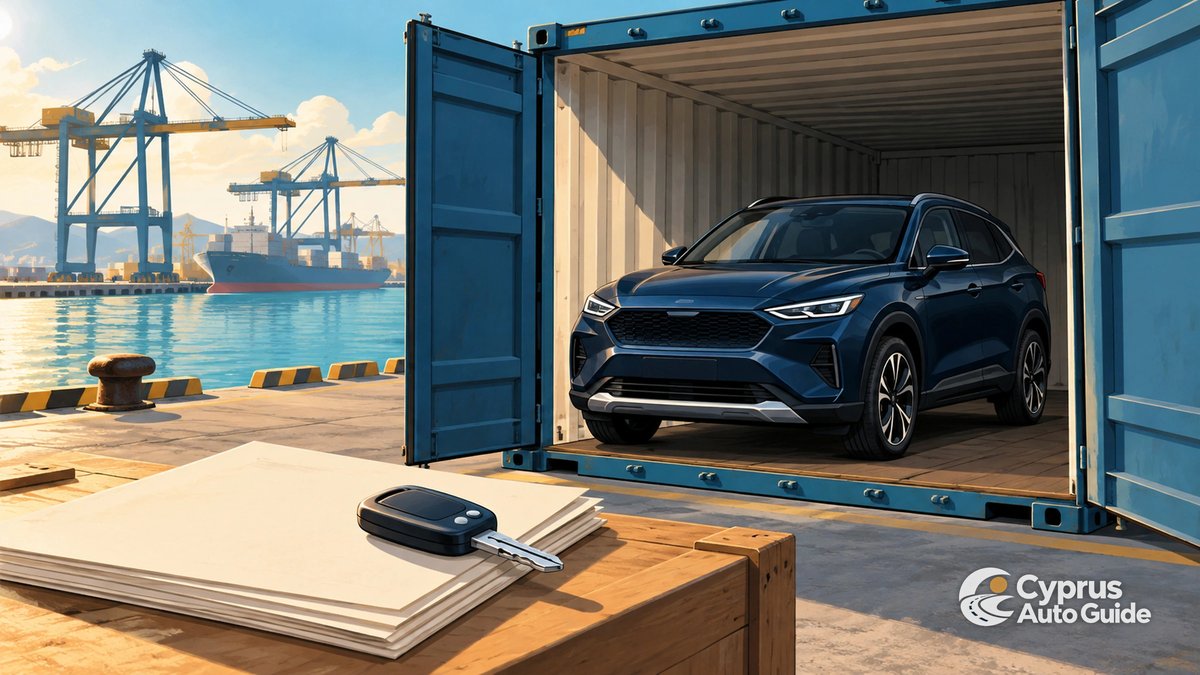
Check Registration Before Shipping
A car can incur shipping and port costs before you discover that registration needs further approval or is not possible in its present form. Ask the Road Transport Department about the exact VIN, age, vehicle category, specification and approval documents before buying or arranging transport.
This guide explains the customs questions to ask. It does not certify registration eligibility, including age, emissions, type approval or steering-position requirements.
Duty And VAT Are Separate
Cyprus Customs gives a normal passenger-car import duty of 10% of customs value and VAT of 19% for non-EU imports, subject to classification, origin, relief and the applicable taxable value.
These figures are a starting point from Cyprus Customs guidance, not a quotation for every import. Vehicle category, customs value, preferential origin, relief and the nature of the movement can change the result. VAT is not necessarily calculated on the purchase price alone, so do not simply add percentages to an advert and treat that as the final bill.
Request a written assessment or properly qualified estimate showing its assumptions. Include freight, insurance and other relevant costs in the information supplied to the customs professional.
A UK Purchase Does Not Prove UK Origin
The Customs page for UK vehicles distinguishes ordinary import treatment from EU-UK preferential-origin rules. UK registration, a UK seller or shipment from a British port does not by itself prove qualifying UK origin.
Ask what documentary origin evidence is acceptable for the particular vehicle and whether the seller can provide it. A manufacturer's brand name is not enough to establish where the car meets the relevant origin rules. If the evidence is uncertain, budget using a clearly labelled non-preferential scenario until Customs confirms otherwise.
Reliefs And Temporary Movements
A permanent import, temporary admission and a transfer of normal residence are different situations. Do not borrow conditions from one and apply them to another. Ask Customs which process matches your circumstances and what restrictions may apply after entry, including use or disposal of a vehicle admitted under relief.
Do not ship on the strength of an informal assertion that “expats pay no tax”. Eligibility and documentary proof need assessment before the cost becomes unavoidable.
Documents And Costs To Assemble
Collect proof of purchase, original registration, VIN and specification, shipping papers and any origin or relief evidence. Ask the agent which originals are required and whether translations or additional approvals are needed.
Build a cost sheet covering transport, transit insurance, port charges, storage, agent fees, duty/VAT assessment, technical work, inspection, registration and annual ownership expenses. Include a reserve for unresolved work rather than inventing a universal import-cost allowance.
Commission a vehicle inspection before purchase where practical. Transport insurance, a seller's warranty and later motor insurance cover different risks and periods.
Decide Using Comparable Alternatives
Compare the resulting documented cost with a locally available vehicle and the cost of interim mobility while you wait. The relocator guide helps structure that decision. For a car moving from another EU member state, read the EU import guide instead of assuming the UK procedure applies.