
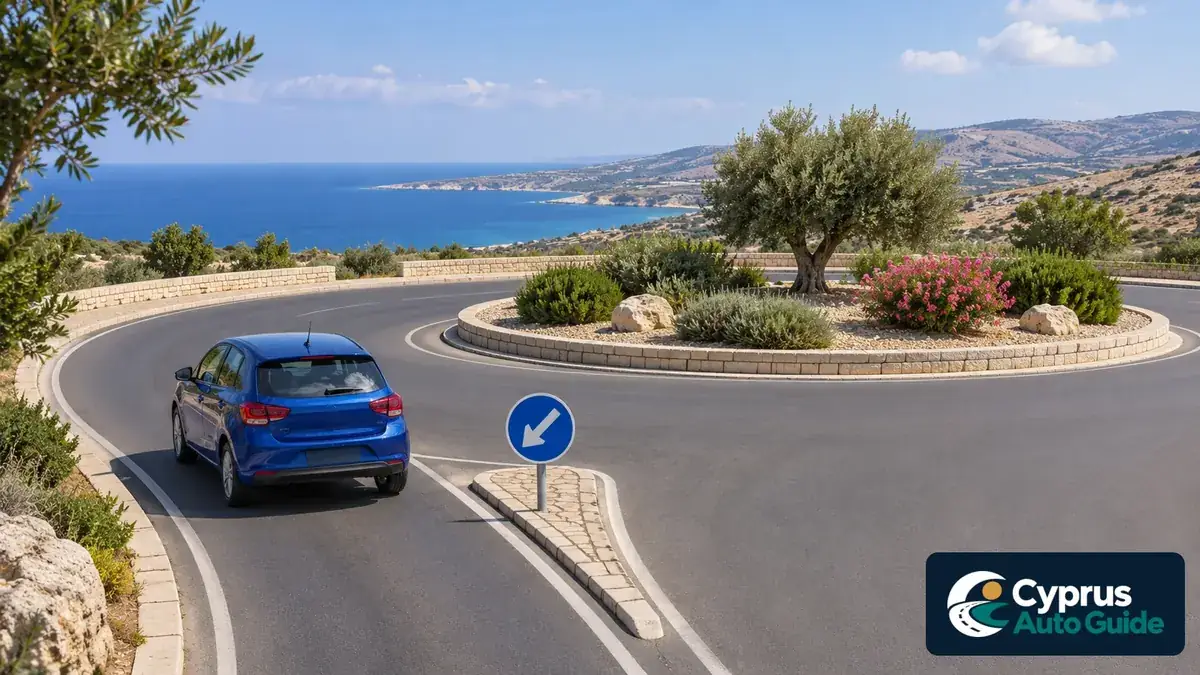
For drivers arriving from Israel, Cyprus changes the side of the road. Kilometres, seat belts and familiar controls remain; turns, roundabouts and overtaking need a conscious reset. Before collecting a car, settle your licence documents and deposit card. Moving rather than visiting adds licensing and ownership checks. This guide covers the Republic of Cyprus.
Reset Your Position Before The First Journey
Drive on the left. In a typical right-hand-drive rental, the centre of the road is on your right and the kerb on your left. Adjust both mirrors while parked and locate the indicators, lights and gear selector. An automatic can reduce the number of unfamiliar actions; confirm the transmission in your booking.
At roundabouts, traffic circulates clockwise. Give way to vehicles approaching from your right unless signs direct otherwise. Choose the marked lane for your exit, check mirrors and signal before leaving. Do not cut across another lane to rescue a missed exit; follow the permitted route and let navigation recalculate.
Pay particular attention when leaving a petrol station or turning from a quiet side road. Re-establish the left lane instead of following muscle memory. On motorways, keep left and use the right lane for overtaking when permitted. Plan a straightforward first drive, with the left-side driving guide as preparation.
An Israeli Licence: Visits And Residence Are Different
Israel's Transport Ministry instructs Israeli licence holders travelling abroad to obtain an international driving permit and carry it with their valid Israeli plastic licence. Take both originals. That instruction does not settle every Cyprus recognition rule or rental condition.
For a short visit, confirm with the supplier that your documents, vehicle category and driving experience meet its conditions. Ask Cyprus's Road Transport Department about the permitted duration and any permit requirements for your Israeli licence. The current Israel-specific visitor period could not be confirmed from the authoritative material reviewed, so do not assume that an online claim of several months applies to you.
For a longer stay or a move, ask the department when you need a Cypriot licence, whether exchange is available and whether tests are required. Its conversion procedure depends on the issuing country; it does not establish automatic exchange for Israel. An international permit does not settle resident licensing obligations. The licence guide explains the questions to resolve.
Familiar Units, Different Speed Expectations
Cyprus uses kilometres per hour. For ordinary passenger cars, the general limits are 50 in built-up areas, 80 outside them and 100 on motorways, unless signs indicate otherwise. Do not carry over the motorway speed you use in Israel. Match the actual restriction and reduce speed for conditions.
The official road-safety programme identifies speeding, red-light and stop-line violations as camera-enforced offences. Stop behind the line and do not treat another driver's behaviour or a navigation alert as permission. No assumed camera tolerance should become your driving limit. With a rental, a supplier's administration charge can be separate from the official fine: read any notice and the agreement before paying.
Seat belts and appropriate child restraints remain essential. Set navigation before moving and keep your phone out of your hands. Familiar safety habits matter especially while you are learning a different road layout.
Fuel, Motorways And Parking
Fuel is sold by the litre, with prices in euros. Confirm petrol or diesel from the car's fuel label and rental paperwork; never choose by nozzle colour alone. At an automated pump, read the payment instructions and keep the receipt. Check the agreed return fuel level before your last journey.
Cyprus motorways have no tolls. Fuel and parking still belong in the trip budget, but there is no motorway toll payment to arrange.
Do not interpret kerb markings through Israeli parking habits. Visit Cyprus explains that double yellow lines prohibit parking and waiting; a single yellow line prohibits parking. Read local signs and payment instructions, including permitted hours. Other parked cars do not establish permission, and an Israeli parking app is not evidence that the local parking charge has been paid.
The Card That Pays May Not Secure The Deposit
Payment and the security deposit are separate checks. A successful online payment does not prove that the desk will accept the same card for its hold. Confirm whether your offer requires a physical credit card in the main driver's name, whether debit is accepted and how much available balance is needed. Do not arrive relying solely on a virtual card or phone wallet.
Ask how the deposit is released and how it differs from the damage excess. Extra insurance does not automatically remove the hold. Keep the answers with the booking and use the deposit and payment-card checklist.
Crossing The Green Line
Before taking a rental across the Green Line, establish supplier permission, territorial third-party cover, protection for the rental car itself and breakdown recovery separately. Insurance offered at a crossing cannot override a contractual prohibition or automatically cover damage to the hired car. Read the Green Line rental guide before choosing the car or planning that journey.
Buying Or Keeping A Car Changes The Checklist
A car kept in Cyprus needs attention between visits too. Check its road-tax status, roadworthiness certificate (MOT) and insurance separately. The Road Transport Department requires valid roadworthiness and insurance documentation for renewal where applicable. Ask about formal immobilisation if the car will be unused; parking it does not itself stop road-tax obligations.
Compare models and prices with the Israeli market, then obtain Cyprus-specific insurance and maintenance estimates before deciding. Use the buying guide for the transaction checks.
Bringing your Israeli car involves an import from outside the European Union. Before shipping, ask Customs about duties, VAT and any residence-transfer relief, and ask the Road Transport Department whether that particular vehicle can be registered. Customs clearance and registration are separate stages. An EU-import checklist alone does not answer those questions.